
Articles
Sex Hormones Explained: How They Work in Women and Men
Women and men share sex hormones. Learn how glands, enzymes and receptors shape their effects, why levels vary, and why a blood test needs context.


By hghthai.com Editorial Team
Women naturally make testosterone and other androgens, alongside estrogens and progesterone. Men naturally make estrogens, alongside testosterone. These hormones are part of shared human biology. Their effects depend on how much is present, where it is made or converted, which cells can respond, and the person's stage of life. Calling estrogen a “female hormone” or testosterone a “male hormone” leaves out much of that story. [1]
Understanding this biology helps explain why the same hormone can matter to an ovary, a testis, a bone or a cancer cell in different ways. It also explains why a hormone's name—or one number on a laboratory report—cannot tell the whole story.
This guide explains normal physiology and a few important boundaries. It does not diagnose a hormone deficiency or recommend hormone treatment.
The main sex-steroid families are estrogens, progestogens, and androgens. Estradiol is an estrogen, progesterone is a progestogen, and testosterone and dihydrotestosterone (DHT) are androgens. “Sex steroid” describes a group of related molecules with important reproductive roles; it does not mean they work only in reproductive organs. [5] [6] [7]
Women generally have much lower circulating testosterone than men, but its presence is normal. Ovarian production, adrenal precursors and conversion in other tissues all contribute to women's androgen biology. In men, much circulating estradiol comes from converting testosterone in tissues outside the testes. [4] [9]
There is no single estrogen-to-testosterone ratio that defines health for everyone. Relative levels are only part of the explanation: tissues also differ in the enzymes and receptors that let them use a hormone. [1]
The hypothalamus, a small region of the brain, releases gonadotropin-releasing hormone (GnRH) in pulses. GnRH reaches the nearby pituitary gland, which releases luteinizing hormone (LH) and follicle-stimulating hormone (FSH). The pulse pattern is part of how this signaling system is regulated. [8]
LH and FSH travel through the blood and act on cells in the ovaries or testes. They are protein-based messages telling cells what to do. LH and FSH are not ingredients that are chemically converted into estrogen, progesterone or testosterone. The steroid-building pathway starts with cholesterol, discussed below. [2] [3]
Within a developing ovarian follicle—the structure surrounding an immature egg—LH stimulates theca cells to make androgens. Nearby granulosa cells respond to FSH and can convert androgen precursors into estrogens. This cooperation supports follicular development and estradiol production. Around ovulation, an LH surge helps trigger egg release; the remaining follicle forms the corpus luteum, which produces progesterone. [2]
LH stimulates Leydig cells in the testes to make testosterone. FSH acts on Sertoli cells, which support developing sperm. Testosterone within the testes also supports sperm production. A blood testosterone result is therefore not a direct measurement of sperm production or fertility. [3]
Sex steroids feed information back to the brain and pituitary, often reducing further stimulation. Another hormone, inhibin, helps regulate FSH. Feedback is not always a brake: sustained high estradiol before ovulation can switch the ovarian system toward positive feedback, helping produce the LH surge. [2] [3]

The hypothalamus releases GnRH in pulses. The pituitary releases LH and FSH. These signals act on ovarian and testicular cells. Sex steroids and inhibin participate in feedback; inhibin particularly regulates FSH. LH and FSH do not become steroid molecules.
Cholesterol is a starting material for steroid hormones. In steroid-producing cells, enzymes first convert it to pregnenolone. Further enzyme steps lead through branching pathways to progesterone, androgens and estrogens. Which products a cell makes depends on its enzyme machinery. This is not a reason to increase dietary cholesterol or take hormone precursors. [4] [5]
The ovaries and testes are major contributors, but they do not work alone. The adrenal glands, above the kidneys, supply precursors such as dehydroepiandrosterone (DHEA), its sulfate form DHEAS, and androstenedione. Other tissues can convert these into more active sex steroids. Adrenal androgen production is influenced by adrenocorticotropic hormone (ACTH), a different pituitary signal from LH and FSH. [4]
Two conversions are especially useful to understand:
These conversions happen where the relevant enzymes are available, including reproductive organs and tissues such as fat, skin and bone. A hormone can therefore be made or changed close to where it acts; blood concentrations do not capture every local process. [9] [10]

Steroid synthesis begins with cholesterol, then pregnenolone. Further enzyme steps lead through progesterone and androgen pathways; these are not shown in full. In tissues with the appropriate enzymes, testosterone can become estradiol via aromatase or DHT via 5-alpha reductase. DHT is not aromatized.
Estradiol (E2) is a prominent estrogen during the reproductive years. Estrone (E1) and estriol (E3) are other naturally occurring estrogens, with different patterns across life and pregnancy. Estradiol helps regulate the menstrual cycle, supports growth of the uterine lining and contributes to breast development. Estrogen signaling also matters to bone. [6]
In men, estrogen is part of normal physiology, including skeletal maturation and maintenance. Its roles in male reproductive tissues are complex; some details are better established in animal studies than in humans. This biology does not mean that raising or lowering estrogen will improve a person's fertility or health. [9]
After ovulation, progesterone helps transform the estrogen-prepared uterine lining into a state that can support implantation. If pregnancy does not occur, the corpus luteum regresses and progesterone falls. During pregnancy, the placenta becomes an important progesterone source. [7]
Progesterone is also part of the wider steroid-synthesis network. Its place in that network should not be confused with a claim that everyone needs progesterone treatment. The words progesterone and progestin are related but not interchangeable: progestins are synthetic substances with progesterone-like actions. [4] [7]
Androgens include testosterone and DHT. Their actions contribute to reproductive development and function, hair and skin biology, and muscle. Testosterone can act directly through an androgen receptor or become a different active hormone through tissue conversion. DHT has strong androgen-receptor activity, but it is not responsible for every effect associated with testosterone. [5]
Women also have androgen-responsive tissues. This does not make testosterone a simple measure of energy, motivation, sexual wellbeing or femininity. Those experiences involve multiple biological and personal factors; the presence of a hormone or its receptor does not establish a benefit from taking more of it. [1]
A receptor is a protein that receives a particular signal. Estrogen receptors, progesterone receptors and androgen receptors help cells respond to their corresponding hormones. Many sex-steroid effects involve receptors inside cells that change gene activity; additional signaling routes also exist. [1] [5]
The response also depends on the cell's other proteins and enzymes. A bone cell and a reproductive cell can receive the same hormone yet respond differently. Hormone concentration, local conversion and receptor function work together; no single one explains the whole response. [1]
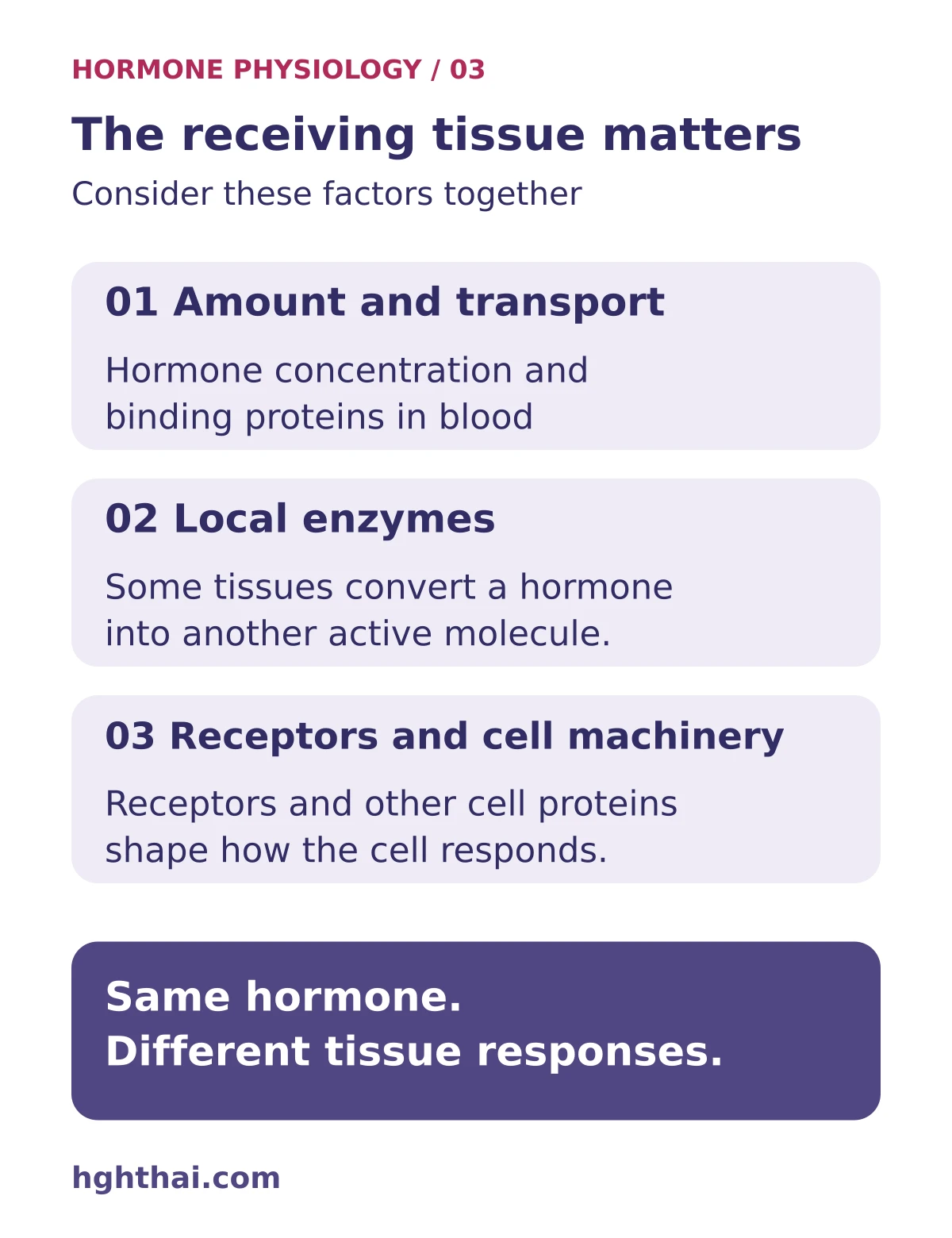
Consider hormone amount and transport, local conversion by enzymes, and receptors with the cell’s other proteins together. The same hormone can have different effects in different tissues. Blood concentration alone does not describe all tissue activity.
Some established breast cancers have estrogen receptors, progesterone receptors, or both. These are called hormone receptor-positive cancers, and hormone signals can support their growth. Other breast cancers lack these receptors. Not all breast cancers are hormone-sensitive. Receptor status is assessed in tumor tissue; it cannot be read from an ordinary blood estrogen or progesterone result. [13]
In androgen-sensitive prostate cancer, testosterone and DHT can support cancer-cell growth through androgen receptors. This describes a feature of those cancer cells and helps explain why the receptor pathway matters in oncology. It is not a prediction that someone with testosterone in their body will develop prostate cancer. [14]
Supporting the growth of some existing cancers is different from saying that hormones universally cause cancer. Cancer involves changes in cells and the systems controlling their growth. Normal physiology, an established tumor's biology and the effects of a prescribed hormone exposure are different questions requiring different evidence. This distinction neither proves that every hormone exposure is risk-free nor tells anyone to start or stop a medicine. [13] [14] [16]
In blood, much testosterone is attached to proteins, including sex hormone-binding globulin (SHBG) and albumin. “Total testosterone” includes both attached and unbound hormone. “Free testosterone” refers to the unbound fraction. SHBG also binds certain other sex steroids, including estradiol. [5] [10]
Binding affects transport and interpretation. A change in SHBG can alter the total result without an equivalent change in the free fraction. That does not mean every bound molecule is permanently inactive, or that a free-hormone test is always the best test. Measurement methods and the clinical question matter. [10]
Physiology is dynamic. The pattern that makes sense in one setting may not apply in another:
One isolated value, separated from that context, is not a diagnosis. For example, Endocrine Society guidance for men requires compatible symptoms or signs and consistently low testosterone when diagnosing hypogonadism. This is a male diagnostic principle, not a rule defining a testosterone-deficiency syndrome in women. [12]
Fatigue or changes in sexual wellbeing can have hormonal and nonhormonal explanations. Recognizing this uncertainty is a reason for thoughtful assessment, not a reason to order every hormone test. For the assessment side of the question, read our guide to hormonal changes and when symptoms need assessment. [10] [12]
Understanding how hormones work does not establish a need to take them. Treatment for a diagnosed condition has a different purpose and evidence base from hormone use for bodybuilding, wellness, longevity or anti-aging. A useful consultation starts with the question being investigated and the person's circumstances. [5] [12]
For brief local context, a Thai FDA report published on 30 June 2026 described a 23 June 2026 operation involving alleged unregistered anabolic-steroid production in a Bangkok condominium. That report concerns a specific enforcement event; it does not establish the authenticity of any other seller or the suitability of hormone treatment. [15]
If you choose to seek care, look for a qualified professional whose identity and qualifications you can verify, at a clearly identifiable clinic. Ask for an explanation of what is known, what remains uncertain and why a particular next step is being considered. You should have room to ask questions without pressure to purchase.

Four ideas to keep
- Women and men share sex-hormone families.
- Brain signals regulate production; enzymes build and convert steroids.
- Tissues and receptors help determine the response.
- A hormone result needs physiological and clinical context.
Yes. Women's androgen biology includes ovarian production, adrenal precursors and conversion in other tissues. Testosterone being present is normal; its level must be interpreted in context. [4]
Estrogen is part of normal male physiology, including bone health. Men produce estradiol partly by converting testosterone through aromatase. That does not mean an estrogen supplement is needed. [9]
No. They are signals that act on ovarian and testicular cells. Cholesterol is the starting material for steroid synthesis; LH and FSH do not become steroid molecules. [3] [4]
No. DHT is a different androgen that can be made from testosterone by 5-alpha reductase. Both can act through androgen receptors, but DHT cannot become estrogen through aromatase. [5]
A result may provide useful information, but it needs the person's history, physiological context and an appropriate measurement method. An isolated value is not a complete diagnosis. [10] [12]
No. Hormone signaling can support growth in some established cancers, but the presence of normal hormones is not a cancer diagnosis or an individual prediction. Tumor biology and personal risk require their own assessment. [13] [14] [16]
Sources last checked on 7 September 2026. Dates below are source publication or update dates, not the date this article was medically reviewed.
1. Stephen R. Hammes; Ellis R. Levin. Impact of estrogens in males and androgens in females. 2019-05-01.
2. Beverly G. Reed; Bruce R. Carr. The Normal Menstrual Cycle and the Control of Ovulation. 2018-08-05.
3. Liza O’Donnell; Lee B. Smith. Endocrinology of the Testis and Spermatogenesis. 2026-01-07.
4. Athanasios Antoniou-Tsigkos; Evangelia Zapanti; Lucia Ghizzoni; George Mastorakos. Adrenal Androgens. 2019-01-05.
5. David J. Handelsman. Androgen Physiology, Pharmacology, Use and Misuse. 2020-10-05.
6. Society for Endocrinology, You and Your Hormones. Oestradiol. 2021-07.
7. Society for Endocrinology, You and Your Hormones. Progesterone. 2021-03.
8. Society for Endocrinology, You and Your Hormones. Gonadotrophin-releasing hormone. 2021-05.
9. Vincenzo Rochira; Cesare Carani. Estrogens, Male Reproduction and Beyond. 2023-03-21.
10. Stephen J. Winters. Laboratory Assessment of Testicular Function. 2026-03-28.
11. Cassandra Roeca; Zain Al-Safi; Nanette Santoro. The Postmenopausal Women. 2025-09-30.
12. Endocrine Society; Shalender Bhasin and guideline panel. Testosterone Therapy for Hypogonadism Guideline Resources. 2018-03-19.
13. US National Cancer Institute. Tests for Breast Cancer Biomarkers. 2025-12-02.
14. US National Cancer Institute. Hormone Therapy for Prostate Cancer. 2024-10-04.
15. Thai FDA Complaint and Enforcement Management Center (CEMC). Report on unregistered anabolic-steroid manufacturing in a Bangkok condominium (Thai-language release; title translated). 2026-06-30.
16. US National Cancer Institute. What Is Cancer?. 2026-08-28.
Women and men share sex hormones. Learn how glands, enzymes and receptors shape their effects, why levels vary, and why a blood test needs context.

Learn when hormonal changes may need assessment, how testosterone and menopause pathways differ, and why AAS use and adult GHD require separate care.

How Your Body Truly Recovers — a Science-Based Guide หมายเหตุสำหรับคนไทย: บทความนี้เขียนเป็นภาษาอังกฤษเป็นหลักแต่มีภาษาไทยสั้น ๆ แทรกไว้ เพื่อให้คนไทยอ่านแล้วจับประเด็นได้ง่ายขึ้น Most people believe that physical improvement happens during exercise, but true